
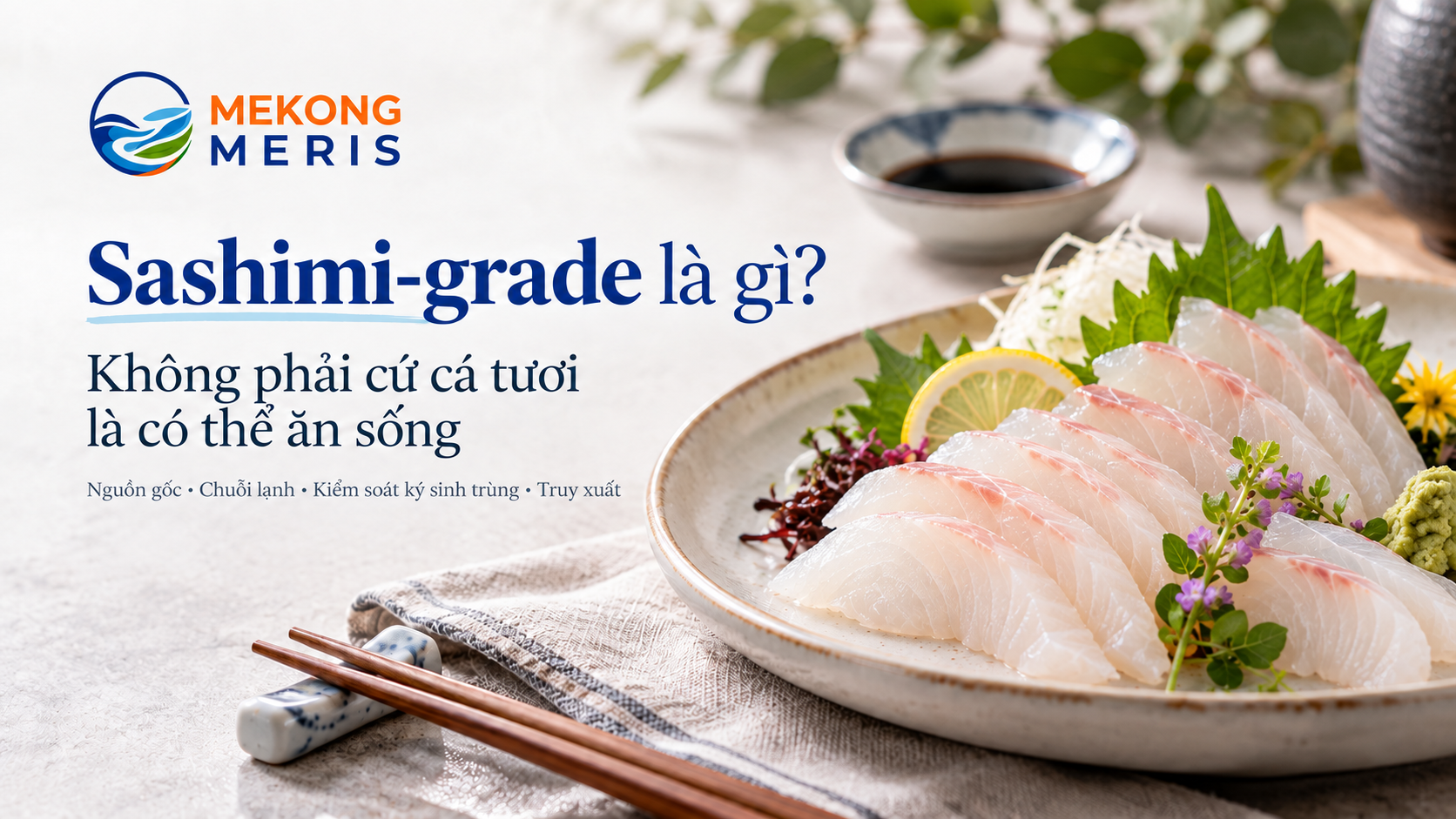
When encountering a fish fillet with vivid color, resilient firm flesh, and freshly retrieved from a chilled showcase, many naturally assume: “With fish this fresh, it can surely be eaten as sashimi.”
However, when seafood is consumed raw, sensory freshness is merely one component of the equation.
Behind an authentic slice of sashimi lies an intricate regimen of raw material selection, parasite risk management, hygiene, deep-freezing, cold chains, and verified traceability.
Sashimi has long been an integral culinary pleasure for food lovers in Vietnam. Alongside the widespread popularity of Japanese gastronomy, terms like “sashimi-grade” and “sushi-grade” appear with increasing frequency on retail packaging, restaurant menus, and seafood counters.
At first glance, “sashimi-grade” creates the impression of an official regulatory quality classification or government certification designating fish as safe for raw consumption.
The regulatory reality is significantly more nuanced.
What Does “Sashimi-Grade” Truly Mean?
In simple commercial practice, “sashimi-grade” is an industry trade term used by suppliers to describe seafood selectively harvested and handled specifically for raw consumption dishes such as sashimi or sushi.
However, this phrase should not be mistaken for an official government-issued food safety certification.
In the United States, the Food and Drug Administration (FDA) does not maintain an official product certification titled “sashimi-grade”. Instead, the regulatory framework focuses on identifying and controlling specific hazards inherent to seafood through Seafood HACCP and regulatory guidance governing parasites, microbial pathogens, marine toxins, and temperature control.
The FDA defines HACCP as a systematic management system addressing food safety through the analysis and control of biological, chemical, and physical hazards across all stages from raw material sourcing and procurement to finished product distribution.
“What truly matters is not whether the words ‘sashimi-grade’ appear on a carton sleeve, but the verifiable hazard control measures operating behind that product.”
Does Exceptional Freshness Mean Fish Can Be Eaten Raw?
No.
This is one of the most widespread and persistent misconceptions surrounding sashimi.
Freshness is undeniably vital for flavor, color, aroma, and mouthfeel. However, an immaculate sensory appearance reveals nothing about whether the flesh harbors microscopic parasite larvae or pathogenic bacteria.
The FDA explicitly notes that parasite larvae in raw or undercooked finfish can pose serious risks to human health, including anisakiasis and other parasitic infections.
The World Health Organization (WHO) similarly confirms that humans contract foodborne trematodiases when consuming raw, pickled, or inadequately processed fish or crustaceans containing infective parasite larvae.
“Freshness is a sensory quality attribute. Suitability for raw consumption is an entirely different domain governed by food safety risk management.”
Why Freezing is Essential for Finfish Intended for Sashimi
Many consumers still harbor the belief that true sashimi must be “never frozen”.
From a microbiological and food safety standpoint, the reality is the exact opposite.
The FDA Food Code prescribes specific parasite destruction freezing protocols for fish species intended for raw, raw-marinated, or ready-to-eat consumption.
Depending on operational parameters, standard validated protocols include:
- Freezing and storing at −20°C (−4°F) or below for a minimum of 7 days (168 hours);
- Freezing at −35°C (−31°F) or below until solid and storing at −35°C for at least 15 hours;
- or Freezing at −35°C until solid and storing at −20°C or below for at least 24 hours.
Note: The above parameters represent statutory guidelines under the U.S. FDA Food Code, containing specific exemptions for certain aquaculture conditions; they are not universal across all species globally.
“For raw seafood products, deep-freezing is not merely a method to extend shelf life. It serves as a vital critical control measure to eliminate parasite hazards.”
Freezing Does Not Eliminate All Hazards
Undergoing a validated deep-freezing cycle for parasite control does not render a seafood product sterile or universally immune to food safety risks.
The FDA underscores that while deep-freezing effectively destroys parasites, it does not eradicate pathogenic bacteria, viruses, or bacterial spores.
Consequently, pristine sanitary handling, strict cold-chain maintenance, avoidance of cross-contamination, and clean processing facilities remain paramount.
What Matters More Than the Words “Sashimi-Grade”?
Where was the fish raised or harvested? Is it wild-caught or farmed in controlled waters? Are lot records transparent?
Did the processor explicitly design and validate this specific SKU for raw consumption?
For this specific species, how were parasite risks evaluated, monitored, and eliminated?
How were filleting, portioning, slicing, and packaging sanitized to prevent microbial contamination?
Are mandatory storage temperatures, safe thawing methods, and post-thaw handling timeframes clearly provided?
“These questions carry infinitely greater value than simply asking: ‘Is this fish fresh?’”
Is Farmed Fish Automatically Safer for Sashimi?
One should not make sweeping assumptions.
The FDA Food Code provides specific parasite destruction exemptions for certain farmed fish species when strict dietary feed controls and environmental certifications are documented.
However, simply seeing the words “farm-raised” does not automatically license an item for raw consumption.
Safety must be established based on species, feeding conditions, processing hygiene, and verified facility standards.
Is Frozen Sashimi Necessarily Inferior to “Fresh” Sashimi?
A binary comparison between “fresh” and “frozen” misses the mark entirely.
Freezing can affect cellular integrity and drip loss if inappropriate blast-freezing technology or reckless thawing is applied.
Yet advanced cryogenic and IQF freezing represents an indispensable instrument for microbiological preservation and parasite elimination.
Finished culinary excellence depends upon multiple cumulative factors:
- initial vitality of the raw harvest;
- time elapsed from harvest to processing;
- freezing methodology and speed;
- unbroken cold-chain storage (−18°C or below);
- barrier packaging integrity;
- controlled refrigerator thawing.
“The intelligent question is not ‘Is this fish fresh or frozen?’, but ‘How was this fish treated from the moment of harvest until it reached my plate?’”
“Sashimi-Grade” Does Not Eliminate Inherent Consumption Risks
Consuming raw animal proteins inherently carries a different risk profile than consuming thoroughly cooked foods.
The FDA reminds consumers that proper cooking is the most reliable defense against foodborne illnesses.
High-risk populations—including pregnant women, young children, the elderly, and immunocompromised individuals—should exercise heightened caution with raw or undercooked seafood.
From a Marketing Catchphrase to Genuine Quality Governance
In modern retail, terms like “premium”, “export quality”, or “sashimi-grade” can be placed on packaging with ease.
Yet true quality is never created by words.
It is created by traceable origins, disciplined process controls, and verifiable evidence.
At Mekong Meris, we believe discerning consumers deserve much more than a generic reply to “Does this taste good?”.
They have the right to ask:
“Where did this originate?”
“How was it processed?”
“Why can I trust what is printed on the package?”
For foods savored in their purest, most natural state like sashimi, those questions matter most of all.
“A great culinary experience does not begin merely with great flavor. It begins with clear understanding and peace of mind born of verifiable facts.”
References
-
U.S. Food and Drug Administration (FDA) — Fish and Fishery Products Hazards and Controls Guidance
https://www.fda.gov/food/seafood-guidance-documents-regulatory-information/fish-and-fishery-products-hazards-and-controls -
U.S. Food and Drug Administration (FDA) — Selecting and Serving Fresh and Frozen Seafood Safely
https://www.fda.gov/food/buy-store-serve-safe-food/selecting-and-serving-fresh-and-frozen-seafood-safely -
FDA Food Code
https://www.fda.gov/food/fda-food-code/food-code-2022 -
World Health Organization (WHO) — Foodborne trematode infections
https://www.who.int/health-topics/foodborne-trematode-infections