
Over 10,000 tons of pigs fed with the banned leanness-enhancing substance Salbutamol were distributed into the consumer market.
Behind this startling figure lies a far more profound question for every household:
“When food is arranged on retail display counters, do we genuinely know where it originated and what journey it underwent before arriving at our tables?”
In the vast majority of cases, consumers cannot answer that question by visual inspection alone.
And that is precisely why food traceability has become an increasingly indispensable pillar of responsible purchasing decisions.
Over 10,000 Tons of Salbutamol-Fed Pork Distributed
On 5 October 2026, Ho Chi Minh City Police announced preliminary investigative findings into an illicit distribution network utilizing Salbutamol in pig farming.
According to official releases, the ring purchased mature pigs weighing approximately 100–110 kg each, transferred them to fattening facilities, and introduced Salbutamol-adulterated feed over a short cycle prior to slaughter and distribution.
Investigative authorities determined that more than 10,000 tons of pigs treated with the banned leanness-enhancing agent had reached the market, with an estimated commercial value exceeding VND 600 billion.
The released records indicated this pork had circulated across Ho Chi Minh City, Dong Thap, and several southern provinces.
The sobering takeaway extends well beyond the sheer scale of the incident.
Once livestock leaves the farm, transitions through abattoirs, cold transit, and retail distribution channels to become packaged cuts, a consumer simply cannot discern that prior journey by looking at the meat.
The cut may still appear vibrant and fresh.
The packaging may be immaculately clean.
The retail outlet may be a familiar, trusted stop.
Yet everything that transpired prior to the product appearing on the shelf lies entirely beyond the consumer's visual perception.
This reality underscores why food traceability is not merely a technical protocol, but a foundational safeguard.
What is Salbutamol?
Salbutamol is not an obscure chemical.
It is an established pharmaceutical active ingredient belonging to the beta-2 agonist bronchodilator class, widely prescribed in human medicine for managing respiratory conditions such as asthma.
A crucial distinction must be drawn:
An active pharmaceutical ingredient that is medically beneficial under strict clinical supervision, proper dosage, and specific indication is emphatically not approved for accelerating growth or artificially enhancing muscle-to-fat ratios in commercial livestock.
When humans are unintentionally exposed to uncontrolled levels of Salbutamol through food consumption, documented adverse reactions include:
- hand tremors and muscle shakiness;
- tachycardia (rapid heartbeat);
- palpitations and nervous anxiety;
- headaches;
- muscle weakness or peripheral cramps;
- disruption of serum potassium homeostasis;
- in severe instances, pronounced arrhythmia or irregular heart rhythms.
The primary concern in food safety is not a sensationalist claim that every single mouthful instantly induces acute illness.
The core danger is that everyday consumers are unknowingly exposed to pharmacological agents without awareness or consent.
With no visibility into concentration.
No visibility into geographical or farm provenance.
No knowledge of administration regimens.
And crucially, no ability to detect contamination through sensory inspection.
Buying Food Based Solely on What We See
When standing before a grocery chiller, most of us naturally evaluate:
- Does the product look fresh?
- Is the packaging intact and clean?
- What is the expiry date?
- Is the price competitive?
- Is the brand familiar?
While all of these criteria matter, they reflect only the final link in an extensive, multifaceted supply chain.
Prior to arriving on display, a product encompasses aquaculture ponds, breeding stock, formulated feed, harvesting regimens, processing parameters, barrier packaging, continuous cold chains, and multi-tier logistics.
If that upstream narrative cannot be audited or inspected, consumer decisions rest entirely on blind trust.
The 10,000-ton Salbutamol incident sharply exposes the vulnerability of relying purely on visual inspection.
You cannot see provenance with the naked eye.
How Can Genuine Food Traceability Make a Difference?
Traceability is not a magical sticker.
A QR code printed on packaging does not intrinsically prove product safety.
Its actual value resides wholly within the verified data architecture backing that code.
A meaningful traceability framework must directly link the physical item in hand to verifiable production milestones, including:
- unambiguous product identity;
- authoritative batch or harvest lot identifiers;
- farm and pond origin;
- processing facility certification and audit scope;
- verified journey milestones from dispatch to point of sale.
Under such a system, consumers no longer receive merely a passive assurance:
“Just trust us.”
Instead, the producer provides an open invitation:
“Here is the verified data for you to inspect.”
That is a transformative distinction.
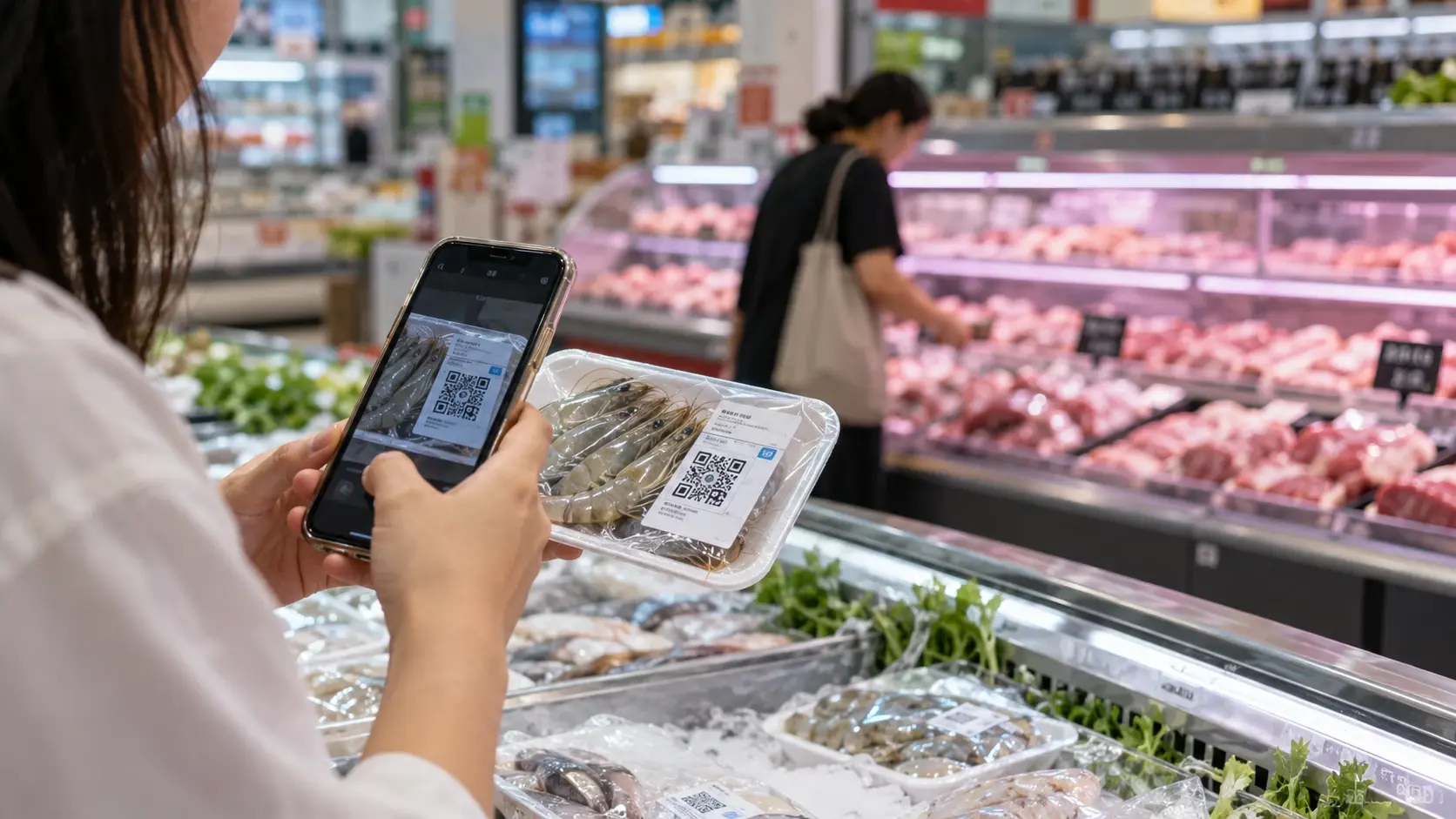
Every Mekong Meris Box Features Barcode and Traceable QR Verification
From the inception of Mekong Meris, our founding principle has been that quality should never be confined to subjective marketing claims on carton sleeves.
Quality requires an auditable foundation.
For this reason, every single box across the Mekong Meris seafood catalog carries a barcode and verifiable QR code.
Our intention is not simply to decorate packaging with digital graphics.
Our purpose is to equip every individual carton with clear identity metadata, allowing consumers to bridge the physical package to authoritative records regarding product grading and lot traceability.
Mekong Meris focuses relentlessly on:
- curating sources strictly aligned with brand quality benchmarks;
- managing granular product and specification data;
- tracking production lots and harvest windows;
- maintaining verified cold-chain conditions (-18°C);
- empowering consumers with verifiable data to validate what they bring to family dining tables.
A QR code only carries meaning when backed by authentic, accessible data.
And data only matters when the enterprise holds full accountability for the information it publishes.
That is the true essence of genuine traceability.
Is It Time to Scan Before You Buy?
We are accustomed to checking the price tag.
We are accustomed to reading expiry dates and nutrition labels.
It is now time to establish an essential new consumer habit:
Verifying origin and provenance.
If a product features a traceability QR code, scan it.
If a brand claims pure provenance, examine the verifiable data they actually provide.
If an enterprise cites international standards, look for the scope, certificate holder, and audit evidence behind the claim.
The lesson of the 10,000-ton Salbutamol case extends far beyond the pork sector.
It poses an urgent question across the modern food landscape:
In an increasingly complex supply chain, what objective evidence will consumers rely upon to know where their food truly comes from?
Going forward, our central question when shopping for food should not merely be:
“Does this look delicious?”
It must also be:
“Can I independently trace the journey of this product?”
At Mekong Meris, we believe provenance transparency is not an optional marketing perk.
It is an inseparable part of quality itself.
Mekong Meris
Curated seafood from the Mekong.
Quality must stand on an auditable foundation.
References
-
Ho Chi Minh City Police — Case disclosure on the illegal pig-fattening network utilizing banned Salbutamol distributed into the commercial market.
https://congan.com.vn/vu-an/cong-an-tphcm-triet-pha-duong-day-vo-beo-heo-bang-chat-doc-hai-roi-ban-ra-thi-truong-hon-10000-tan-heo_198453.html -
VnExpress — “Over 10,000 tons of pigs lean-enhanced with banned substances sold to market”
https://vnexpress.net/hon-10-000-tan-heo-duoc-tao-nac-bang-chat-cam-roi-ban-ra-thi-truong-5128734.html -
NHS (National Health Service - UK) — Salbutamol inhaler – Side effects
https://www.nhs.uk/medicines/salbutamol-inhaler/side-effects-of-salbutamol-inhalers/